The question likes to arrive in the middle of something else. You are driving home from co-op, or standing at the sink, and it taps you on the shoulder: are we on track?
You know where the answer is supposed to live. But you also know what the planner will say, because a planner only knows one way to answer. It shows you the boxes. And the boxes that talk loudest are the empty ones.
So some weeks you don't look. I understand that completely - if looking feels like being graded, not looking is just good sense.
The look-back stings because it starts in the wrong place
Here is what the usual week review actually is, at most houses. You open the planner to this week's page and your eye goes straight to what did not happen. The math row with three checks out of five. The history chapter still sitting where Monday left it. The handwriting column that is just open.
Nothing in you decided to grade the week. The page did it for you, because a plan can only measure the week against the week it expected. August made a guess - a good and loving guess, written in the quiet of summer - and the page is still keeping score for August.
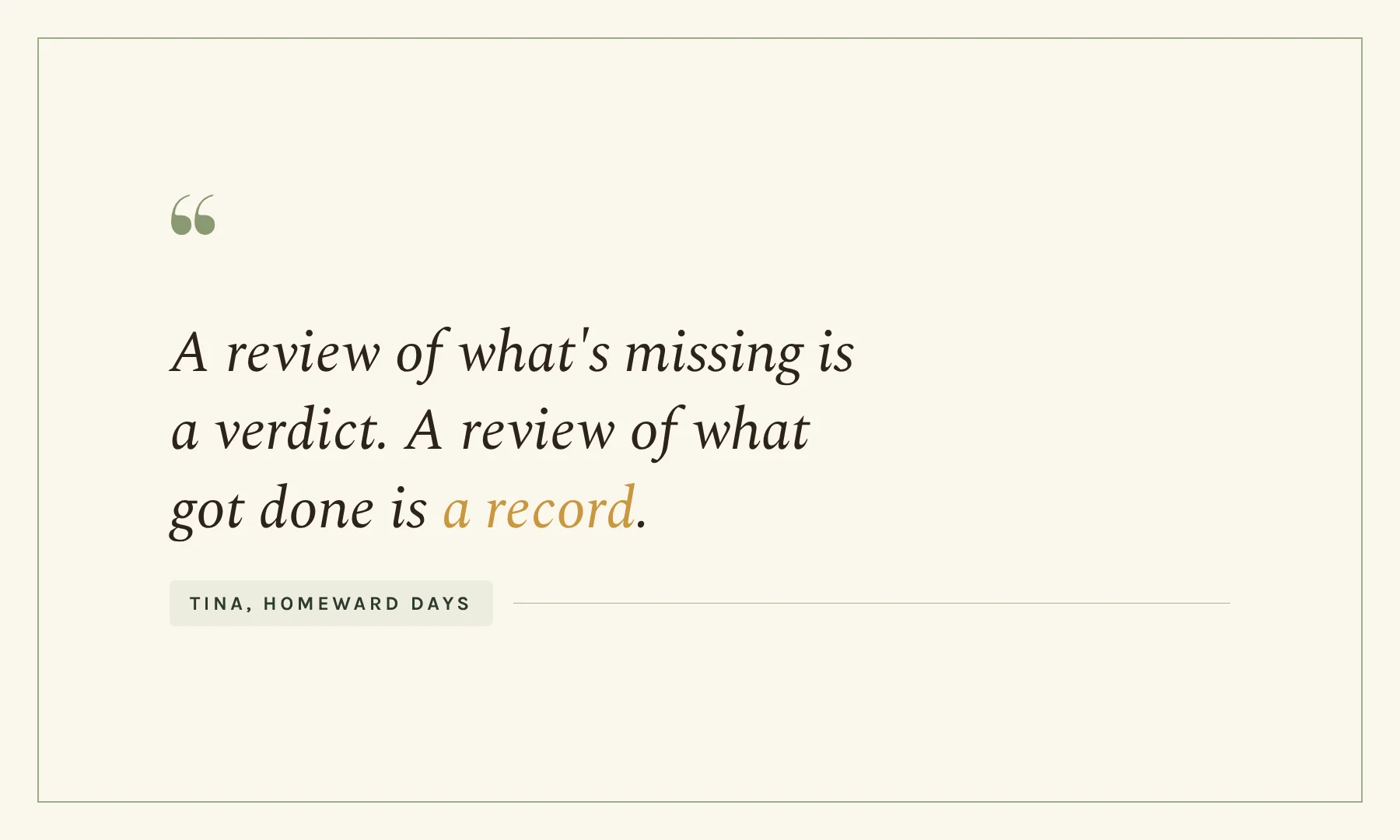
A review that starts with what's missing is a verdict. One that starts with what got done is a record. Same ten minutes. Entirely different mother walking away from the table.
Start with what got done
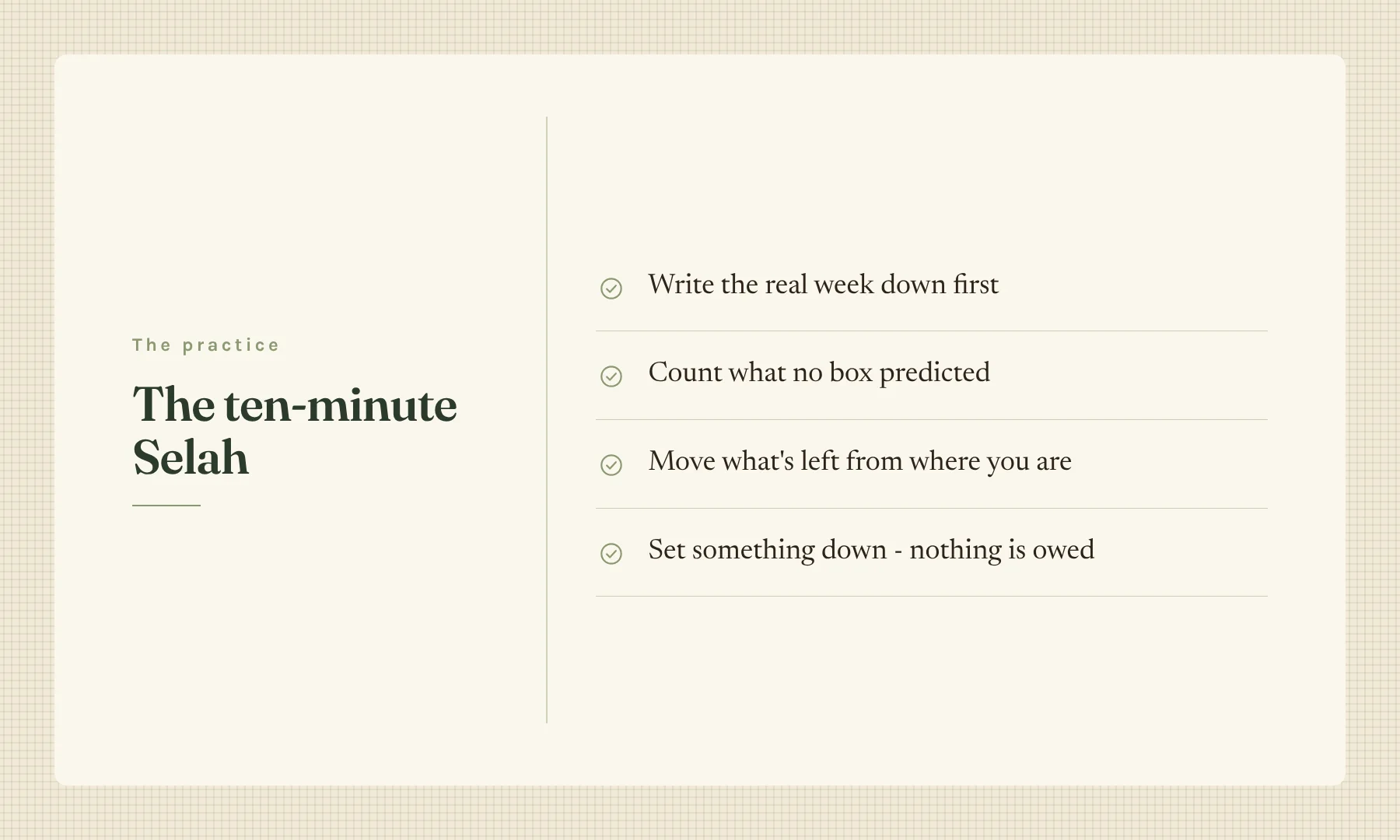
So flip the order. Before you let the plan say one word, write the week down as it actually happened.
Not just the checked boxes - the real week. The read-alouds on the couch. The morning that was supposed to be grammar and turned into an hour on the fall of Rome because somebody asked a real question. The psalm at breakfast, the memory work in the van, the whole afternoon of bread and fractions in the kitchen. None of that waited for a box, and all of it was school.
Write it down and count it. I am not asking you to be generous with yourself. I am asking you to be accurate.
I can tell you where this habit leads, because I have homeschooled for more than twenty years and graduated four of my children. Their transcripts took me many hours and many spreadsheets, and every one was built out of the same raw material: a record of what we actually did. Nobody - not once, not anywhere - ever asked to see my plan. What counted, all the way through to graduation, was what got done.
Then let the plan have its say
Once the real week is written down, open the planner. The conversation is different now, because you are not asking it how you did. You are telling it what happened. You already know how you did.
What is left is arithmetic, and I wrote about that move in my last letter: whatever truly did not happen moves forward from today, not from where August said you would be. Spend a buffer week, if you built your year with room in it. Let the year run a little longer. Or set something down, because nothing is owed.
And some weeks, once the real week is counted, nothing needs to move at all. The week looked thin in the boxes and was full in the living. That is not a trick of bookkeeping. That is what on track actually means in a homeschool: measured against your own plan, from where you actually are. No other measure ever gets a vote.
A little word the Psalms kept
There is a word for this pause, and I did not make it up.
Selah. It appears more than seventy times in the Psalms, often at the end of a line, and nobody is entirely certain what it means. Many take it to mark a rest: stop here. Let what was just said settle before you go on. The Psalms hold some of the hardest, truest lines ever written, and even there, somebody thought to mark the rest.
That is the whole shape of the practice I am handing you. Once a week, stop and look at what the week really held. Let it be counted. Then go on.
When? Whenever you already find yourself looking at the coming week. I recently asked five homeschool mothers when they plan, and I got five different answers: a Friday, the day after co-op, a Saturday glance, and two versions of "as I go." So I will not pretend there is a right hour. The Selah is not an appointment. It is an order of operations: what got done first, the plan second.
The Selah I am building
I am building this order of operations straight into Homeward Days, the homeschool advisor and planner, and I gave the weekly look-back that name on purpose. Selah opens with what got done: it reads your week from the days you checked off and tells you that story first, done out of planned, against your own plan only. When something has to give, setting it down is a real choice with a real name - nothing is owed - instead of a box that goes on glaring at you.
But hear me say it plainly: you do not need my app to start. You need a piece of paper and ten minutes. The practice is yours either way.
This week, in this order
Try it once this week. Write the real week down, count it, and only then let the plan talk. If the question taps you on the shoulder at the sink - are we on track? - you will have an answer that is actually about your year, not about August's guess.
We are getting ready to open, and the founding list is how you hear first. Short letters, and nothing else. If you want in early, join the founding list. And if you know a mom who has stopped opening her planner because of what it will say, send her this letter.
Tina